We are currently sitting in an internet cafe in Santiago awaiting our flight to Panama and eventually home to Canada! We have completed most of our blog entries, but have yet to write the ones for Mendoza and Santiago, so stay tuned for those entries even though we will be back in Vancouver. We have had a fantastic trip, and can´t wait to see you to tell you all about it face to face (we have purposefully left out some of the juicier stories to retell in person). Thanks for reading and your comments, and we look forward to seeing you all very soon!
Cheers!
Katie and Timb
Friday, January 4, 2008

Monday, December 31, 2007
Mendoza
One of the two reasons that Mendoza is famous is that it is the center of Argentia´s wine district. While Argentina wine isn´t exactly world renowned, it is a very fast growing industry and Mendoza has done its best to capitalize on that fact. The popular thing among backpackers, is to rent a bike and ride to a bunch of wineries. A few routes have been set up in areas where there is a fairly high concentrations of vineyards. 
 Following our short hike around Aconcagua National Park, we drove off to Las Cuevas, a town close to the Chilean border. We drove through the town and began to wind our way up a switchbacking gravel road up the side of the mountain. We were climbing to a monument called Cristo Redentor de los Andes monument located at 3800m above sea-level on the Argentinean-Chilean border. The road was once the only way to cross the border, but now a 3km international tunnel cuts through the mountain, eliminating the need to take the winding road over the pass.
The top of the pass was freezing and the wind was blowing hard, chilling us to the bone in seconds. The view, however, was amazing! The snow capped peaks of the Andes stretched out before us in all directions. After snapping a few photos, we were quite cold so we piled back into the van and headed down the mountain.

The last stop on our tour was the Punte de Inca, which despite its name, was not built by the Inca. It is a natural bridge formed from sulphurous deposits spanning the Vacas river. Their are hotsprings located under the bridge, but after an earthquake in 2005 , the bridge was closed as it was unsafe to cross. The bridge was the last stop of the day, and we all piled back into the van for the drive back to Mendoza. After spending a lot of time in big cities was nice to get back out into the mountains and stretch our legs a little.
So we got on a bus that would take us to the outskirts of Mendoza where we would begin the tour. It turned out to be a bit tricky to pay for the bus as, it is very difficult to get change in South America and it only took exact change. After trying to pump the ticket machine full of coins, it finally spit out one ticket. I am not sure if the driver even noticed or cared but we got a ride out to Mapu, a small town outside of Mendoza. Here we payed for our bikes, and set out down the road. 
Our first stop was at the Museo del Vino. This was a small muesum set up at a vineyard, which had a collection of wine making equipment streching back to colonial times. We were given a good tour, in english, that explained how the equipment was used and how it had evolved from collecting graps in baskets made from hide, crushing grapes with their feet and storing it in clay vessels to the modern stainless steel vats and pneumatic press used today.
 After a tour around the museum, we were taken into the modern winery and given a tour of their current operations. It was all very impressive and I actually learned a little about wine making.
  After the tour we were given some wine to sample, a chardonnay, which wasn´t too bad, although whites are not the regions specialty.
After the museum we got back on our bikes and headed off to the next stop, a winery called Vina el Cerno. This winery was a few kilometers away, and by the time we arrived we had discovered how increbily uncomfortable the bike seats were. I have ridden quite a few bikes and nothing compared to how hard and lumpy these seats where. Luckily, we were on a wine tour so we head to the tasting room to dull the pain. At this winery we sampled their chardonnay, cabernt sauvignon, syrah, and their malbec, the varitey the region is famous for. Malbec, is actually the variety looked down on by the French (Mal meaning bad and bec meaning kiss.) I thought it was pretty good but Katie prefered the syarh and the cab sauv. After the wine we got back on the bikes, the seats seamed to be a bit better by then, and headed to our next stop, a winery by the name Bodega Carinae. We arrived just in time to join an english tour that had just started. This winery had just been restarted a few years ago, after being abanonded for a generation. Appartently the son had not want to continue the family business and after the father had died, the vineyard just sold their grapes to other wineries. In 2002 or so a couple had bought the land from the son and started the up the current operation, which had already won a couple of international contests. We tasted several of their varieties and bought a couple of bottles to bring back with us. We also had a picnic lunch in the the vineyards.
 After that we went across the street to visit an olive plantation. We wandered around a bit and sampled some olives and oil in their gift shop but decided not to take the tour. It was getting late and we still had one more winery to visit.

The last winery we visited was called Familia Di Tommaso. We took a short tour of the facilities, which were no longer be used to produce wine. We were able to walk into one of the large storage barrels, which had been cut open for the public to view. The ceiling of the barrel was coated with crystals, which had formed during the many years the barrel had been used for storing and fermenting wine. They were quite beautiful. We tasted a couple of wines, and bought a bottle of Malbec. Then we biked back to the rental place and caught a bus back into Mendoza.

The second trip we did from Mendoza was the Alta Montaña Tour. We had heard from several people that the road from Mendoza into Chile was spectacular and we wanted to see more of it than just from the bus window. We found a tour that would take us to see most of the sites we wanted to visit.
The trip started off with a surprise, due to a unforeseen time change. We were informed, five minutes after waking up, that the tour group was downstairs waiting for us, and that it was eight o'clock, not seven. We threw our stuff together as quickly as possible and headed off for the mountains. The first stop was at a reservoir that supplied Mendoza and the surround vineyards with water. The drive up there reminded us how dry this region was and how important this water was in maintaining the productivity of the surrounding area. The reservoir and irrigation system was originally built by the natives, but since had received considerable modification to keep up with modern demands. We continued on stopping at the small town of Uspallata for a snack and Los Penitentes Ski Resort. The next stop was the one I had been looking forward to the most, Aconcagua. At 6962m it is the highest mountain in the Americas and the highest mountain outside of the Himalayas.
  We were able to hike for about an hour on a loop out to a lookout point and back to the park entrance. It was nice to get out of the van and stretch our legs after all that driving. It was a beautiful, clear day, and we enjoyed the chilly sunshine. It was the first time we had to wear jackets for a couple of weeks.
Our first stop was at the Museo del Vino. This was a small muesum set up at a vineyard, which had a collection of wine making equipment streching back to colonial times.
We were given a good tour, in english, that explained how the equipment was used and how it had evolved from collecting graps in baskets made from hide, crushing grapes with their feet and storing it in clay vessels to the modern stainless steel vats and pneumatic press used today. After a tour around the museum, we were taken into the modern winery and given a tour of their current operations. It was all very impressive and I actually learned a little about wine making. After the tour we were given some wine to sample, a chardonnay, which wasn´t too bad, although whites are not the regions specialty.After the museum we got back on our bikes and headed off to the next stop, a winery called Vina el Cerno. This winery was a few kilometers away, and by the time we arrived we had discovered how increbily uncomfortable the bike seats were. I have ridden quite a few bikes and nothing compared to how hard and lumpy these seats where. Luckily, we were on a wine tour so we head to the tasting room to dull the pain. At this winery we sampled their chardonnay, cabernt sauvignon, syrah, and their malbec, the varitey the region is famous for. Malbec, is actually the variety looked down on by the French (Mal meaning bad and bec meaning kiss.) I thought it was pretty good but Katie prefered the syarh and the cab sauv.
After the wine we got back on the bikes, the seats seamed to be a bit better by then, and headed to our next stop, a winery by the name Bodega Carinae. We arrived just in time to join an english tour that had just started. This winery had just been restarted a few years ago, after being abanonded for a generation. Appartently the son had not want to continue the family business and after the father had died, the vineyard just sold their grapes to other wineries. In 2002 or so a couple had bought the land from the son and started the up the current operation, which had already won a couple of international contests. We tasted several of their varieties and bought a couple of bottles to bring back with us. We also had a picnic lunch in the the vineyards.After that we went across the street to visit an olive plantation. We wandered around a bit and sampled some olives and oil in their gift shop but decided not to take the tour. It was getting late and we still had one more winery to visit.The last winery we visited was called Familia Di Tommaso. We took a short tour of the facilities, which were no longer be used to produce wine. We were able to walk into one of the large storage barrels, which had been cut open for the public to view. The ceiling of the barrel was coated with crystals, which had formed during the many years the barrel had been used for storing and fermenting wine. They were quite beautiful. We tasted a couple of wines, and bought a bottle of Malbec. Then we biked back to the rental place and caught a bus back into Mendoza.
The second trip we did from Mendoza was the Alta Montaña Tour. We had heard from several people that the road from Mendoza into Chile was spectacular and we wanted to see more of it than just from the bus window. We found a tour that would take us to see most of the sites we wanted to visit.
The trip started off with a surprise, due to a unforeseen time change. We were informed, five minutes after waking up, that the tour group was downstairs waiting for us, and that it was eight o'clock, not seven. We threw our stuff together as quickly as possible and headed off for the mountains. The first stop was at a reservoir that supplied Mendoza and the surround vineyards with water. The drive up there reminded us how dry this region was and how important this water was in maintaining the productivity of the surrounding area. The reservoir and irrigation system was originally built by the natives, but since had received considerable modification to keep up with modern demands.
We continued on stopping at the small town of Uspallata for a snack and Los Penitentes Ski Resort. The next stop was the one I had been looking forward to the most, Aconcagua. At 6962m it is the highest mountain in the Americas and the highest mountain outside of the Himalayas. We were able to hike for about an hour on a loop out to a lookout point and back to the park entrance. It was nice to get out of the van and stretch our legs after all that driving. It was a beautiful, clear day, and we enjoyed the chilly sunshine. It was the first time we had to wear jackets for a couple of weeks. Following our short hike around Aconcagua National Park, we drove off to Las Cuevas, a town close to the Chilean border. We drove through the town and began to wind our way up a switchbacking gravel road up the side of the mountain. We were climbing to a monument called Cristo Redentor de los Andes monument located at 3800m above sea-level on the Argentinean-Chilean border. The road was once the only way to cross the border, but now a 3km international tunnel cuts through the mountain, eliminating the need to take the winding road over the pass.The top of the pass was freezing and the wind was blowing hard, chilling us to the bone in seconds. The view, however, was amazing! The snow capped peaks of the Andes stretched out before us in all directions. After snapping a few photos, we were quite cold so we piled back into the van and headed down the mountain.
The last stop on our tour was the Punte de Inca, which despite its name, was not built by the Inca. It is a natural bridge formed from sulphurous deposits spanning the Vacas river. Their are hotsprings located under the bridge, but after an earthquake in 2005 , the bridge was closed as it was unsafe to cross.
The bridge was the last stop of the day, and we all piled back into the van for the drive back to Mendoza. After spending a lot of time in big cities was nice to get back out into the mountains and stretch our legs a little.We chose to spend New Year's in Mendoza, as it would be considerably more expensive to spend it in Chile. We decided to head out to the bar district only to find everything closed. There was only one bar/restaurant open and it was packed with tourists. Apparently, residents of Mendoza do not go out for New Year's, although I think they tend to have private family parties. One thing they do like to do is light off fireworks, loud fireworks. We had a mediocre meal, a good bottle of wine and rang in the New Year as explosions rattle the window panes around us.
Buenos Aires - The Good Stuff
We spent a week in Buenos Aires around Christmas. It was swelteringly hot almost everyday, and was honsetly one of the strangest Christmases I have ever experienced. Timb and I both agreed that Christmas lights and decorations in 30 degree heat and bright sunshine felt unnatural. We enjoyed ourselves exploring the city, which is that largest we have encountered on our journey thus far. Here are some highlights from our experiences...

Puerto Madero:
We arrived in Buenos Aires in the morning of a bright sunny day and decided immediately that we had to be out exploring the city on foot. We directed ourselves towards the waterfront and headed out into the warm morning. Puerto Madero is a newly revived area, running alongside the old dikes of the port on the Rio Plata. There are four dikes, filled with murky brown water, surroundedby old warehouses that have been transformed into upscale apartments and restauraunts. It rather reminded us of Yaletown. We wandered in the hot sun along the side of the dikes, pausing on shady benches, and to take a photo in front of a rather magnificent footbridge.
 We crossed the foot bridge and wandered through the neighbourhood towards the waterfront. We strolled along a long footpath running alongside a salt marsh. The whole waterfront area has been revitalized and is now an Ecological Reserve. We intended to explore the reserve, but it was just too hot, so we headed into the Plaza de Mayo for lunch. The plaza is surrounded by some important historical buildings, including the Cathedral and the Casa Rosada, the residence of the president.
  It is also the site of regular protests, so it is gated across the middle, and around the key buildings. We headed back to our hostel along the pedestrian thoroughfare, called Florida. It is a busy mall, lined with shops and people passing out flyers advertising everything from leather goods to strippers. It was packed with people commuting to and from their jobs in the downtown core around Plaza de Mayo.
Recoletta Cemetary and the Museo de Bellas Artes:
On the second day of our time in Buenos Aires we headed to Recoletta Cemetary, a famously elaborate burial grounds filled with the tombs of the Argentinian elite. It was an amazing experience, like walking through a city of the dead.  The tombs were all intricate constructions, some of which still fared well due to continuing maintenace, and others which were crumbling into disrepair. Some of the coffins actually hung out of their stone receptacles, like something out of a Halloween movie.
  We took some amazing photos of the crypts and enjoyed exploring the cemetary to find my ultimate goal, the grave of famed Evita, Eva Peron.
  We discovered it at last, as we suspected, surrounded by a group of tourists snapping photos and paying tribute to the sweetheart of Argentina.
The tombs were all intricate constructions, some of which still fared well due to continuing maintenace, and others which were crumbling into disrepair. Some of the coffins actually hung out of their stone receptacles, like something out of a Halloween movie. We took some amazing photos of the crypts and enjoyed exploring the cemetary to find my ultimate goal, the grave of famed Evita, Eva Peron. We discovered it at last, as we suspected, surrounded by a group of tourists snapping photos and paying tribute to the sweetheart of Argentina.Following our trip into Recoletta Cemetary, Timb and I headed to the Museo de Bellas Artes. This museum was quite large, containing a vast collection of Argentinian art, as well as several travelling exhibitions. It took a couple of hours to explore the whole thing, but was well worth it for me to see a couple of pieces by Monet, Velasquez, Goya and Picasso.
Parks and Palermo:
Parks and Palermo:
On our third day we headed to Palermo and it´s praised parks. We took the Subte, or subway, which was an adventure in itself, as we had to work out how the system worked, and arrived at Plaza Italia in hot sunshine. We wandered from their through the botanical gardens, which had lovely sculptures, but had fallen into a decaying state with the collapse of the Argentinian economy. It was nevertheless a lovely green space, oddly filled with stray cats, a lot of stray cats. They seemed to be congregating there, in liu of other spaces to live. After the botanical garden we headed up to the Japanese Garden, which was well maintained due to the entry fee charged.  It had large ponds, bridges low green hillocks and rock statues, with the biggest coy fish I have ever seen inhabiting the ponds. They honestly looked as if they could take off your hand if you were to dip it into the water. The children would feed them, and they would crowd together under the bridges when you went to cross them.
It had large ponds, bridges low green hillocks and rock statues, with the biggest coy fish I have ever seen inhabiting the ponds. They honestly looked as if they could take off your hand if you were to dip it into the water. The children would feed them, and they would crowd together under the bridges when you went to cross them. Finally that day we went to do a little shopping, or rather I went to do some shopping while Timb patiently waited for me to make up my mind. We headed to an area called Palermo Viejo, or Palermo Soho, which is home to a number of trendy boutiques. This area of Palermo was absolutely gorgeous, with cobbled streets and big trees over hanging the sidewalks. Ladies, I am telling you, it was fantastic! It was like shopping in New York with all of the fabby designer clothes, shoes and bags, but better because the prices were so low. I was in heaven, but had to control my spending as I didn´t have a lot of room to bring things back. I would love to go back with an empty suitcase and fill it up, but until that time I will have to be content with my gorgy, green suede bag that Timb bought me for Christmas :) We wandered around Palermo for a while, admiring the boutiques and trendy cafes before treading back to the Subte station and the hostel.
San Telmo:
San Telmo is a wonderfully unique area of Buenos Aires, and we were lucky enough to be able to explore it on Sunday when the streets are lined with bohemian and antique markets. The building here are lower and older thn in other parts of the city, and the main street is linded with antique shops filled with some really unique objects. When the economy crashed, people began to sell off their possessions to make some money. They sold everything with value, and therefor the antique shops are packed full of everything you can imagine. The whole thing is incredible, and also rather sad, as these people sold their family heirlooms to survive. We wandered down to the main plaza, which turns into an antique market on Sundays, and explored the stalls. It was fun and interesting, but Timb and I both decided that there is a fine line between antique and junk. We ate lunch at a notable restaraunt called Desnivel, an Italian place famous for its delicious steaks. And they really were amazing. The most tender steak I have ever had, though they need to work on their sauces and marinades. We left the restaurant absolutely stuffed, and wandered back, through the rather empty Sunday streets of the rest of Buenos Airies, to our hostel to digest.

Christmas Day and the day that followed:
This year was my first Christmas away from home, and as a result I was rather homesick on Christmas Day. Timb did a great job of trying to cheer me up. He made me a stocking out of one of his socks, with candy and an orange inside, and bought me a rose. We exchanged a couple of presents and went down to have coffee and breakfast. We made a huge breakfast omlet, and checked our e-mails for Christmas greetings. Then we headed out into Buenos Aires to make some phone calls and explore the Congresso area, which we had yet to see. It was a long walk, but worth it, as the archtecture around the plaza is rather spectacular. The government house is massive, and the plaza contains a wonderful large sculpture and fountain. We walked back to the hostel, where we spent the rest of the day hanging out with others in the hostel and watching movies on TV. We made a huge Christmas dinner that night, and all ate and drank together. It was nice to spend the day with new people, and I ended up really enjoying myself on my first hot and sunny Christmas day.
It was a long walk, but worth it, as the archtecture around the plaza is rather spectacular. The government house is massive, and the plaza contains a wonderful large sculpture and fountain. We walked back to the hostel, where we spent the rest of the day hanging out with others in the hostel and watching movies on TV. We made a huge Christmas dinner that night, and all ate and drank together. It was nice to spend the day with new people, and I ended up really enjoying myself on my first hot and sunny Christmas day. The next day was our last in Buenos Aires, so Timb and I decided to cross off the last few activities we had on our list. We had to check out of our room rather early, afterwhich we walked down through Puerto Madero again to reach the Ecological Reserve. This time we headed into the reserve and walked out to view the Rio Plata, the closest point we could get to the Atlantic Ocean. We have now been from coast to coast on the South American continent. The reserve was large, full of low, flowering trees and marsh land grasses. It was nice to feel a bit like we were out of the city. It was a hot day, and we both got rather sunburned walking around in the open. 
Later in the afternoon we headed to the Buenos Aires Zoo, which we had heard contained amazing animal houses. They were quite amazing, as they were old, and architecturally elaborate, but they were not the ideal homes for these animals, and as usual the zoo was a bit depressing. Some of the animals had lovely large habitats, but others were not so fortunate. I particularly felt for the polar bear, who must´ve been boiling hot. The zoo was large and it took us a while to make it all the way round to all of the exhibits. I think that the best thing we got out of our zoo visit was a feeling of accomplishment of our trip in general; of having been able to see many of these animals in their wild habitats, something that many of the other zoo visitors hadn´t done and possible would never see. We had been to the jungle, desert and high altiplane, and those experiences stood out especially with our zoo visit.
Some of the animals had lovely large habitats, but others were not so fortunate. I particularly felt for the polar bear, who must´ve been boiling hot. The zoo was large and it took us a while to make it all the way round to all of the exhibits. I think that the best thing we got out of our zoo visit was a feeling of accomplishment of our trip in general; of having been able to see many of these animals in their wild habitats, something that many of the other zoo visitors hadn´t done and possible would never see. We had been to the jungle, desert and high altiplane, and those experiences stood out especially with our zoo visit.Later that day we left Buenos Aires for Mendoza, and further adventures...
Monday, December 24, 2007
Happy Holidays!
Hello family and friends!
Timb and I would like to wish you a very Merry Christmas from sunny Buenos Aires! We are enjoying our stay here very much, and have been out exploring the city everyday. It is a much different Christmas experience to what we are used to, but it is an enjoyable one none the less. We hope that you all are enjoying your own Christmas holidays, wherever you might be. Eleven more days and then back to the rain. We will see you all soon!
Merry Christmas Everyone!!
Katie and Timb
Timb and I would like to wish you a very Merry Christmas from sunny Buenos Aires! We are enjoying our stay here very much, and have been out exploring the city everyday. It is a much different Christmas experience to what we are used to, but it is an enjoyable one none the less. We hope that you all are enjoying your own Christmas holidays, wherever you might be. Eleven more days and then back to the rain. We will see you all soon!
Merry Christmas Everyone!!
Katie and Timb
Water Falling in the Jungle
We arrived in Puerto Iguazu in the late afternoon heat, and stripped out of our warm clothes before setting out to find a place to stay. The town is small and pleasant, shaded by large trees, and surrounded by jungle and a river bearing the same name that passes alongside it. We selected a hostel, which seemed nice enough, and headed into town to find some dinner. We ate our usual healthy dinner of pizza and beer, and returned to the hostel exhausted from the long bus journey that we have just completed.
Unfortunately, whilest Timb was in the bathroom having a well deserved shower, I discovered that we were not as alone in our room as one would have hoped. I picked up my bag to discover a large black cockroach huddled beneath it. I let out a shriek and it ran, and i jumped back against the wall. As I did so, I spied another cockroach scampering into our room from beneath the door. It was all I could do to keep my composure, as I had never seen a cockroach in real life before, and I am sure Timb would say that I didn´t do a very good job of remaining calm. He emerged from the bathroom, quite confused as to what the problem was, and proceeded to heroically squash all the cockroaches that he could find. I think there were only about 8 in total, but that was enough to make me sleep with one light on, very uneasily. The next morning we made the decision to switch hostels, to a cleaner, bug-free environment.
We set out for the falls that afternoon, taking the local bus to the national park entrance. It was a scorchingly hot day. We took the passenger train out to the path to the biggest set of falls, called Garganta Diablo. A boardwalk through the jungle and over the widely flowing upper Iguazu river lead us out to the waterfall view point. You could hear the water falling before you could see it. The river pounded over the face of the cliff, and incredible amounts of water rushed over the face. It was an amazing site. We took many photos, and then headed back to the train.

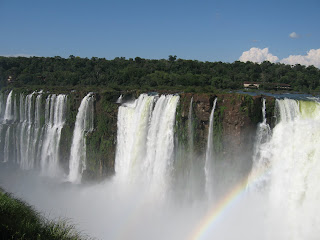
Before we left the park that day, we explored the second of three trails to the water falls, the upper trail. Another boardwalk followed along the upper portion of the falls, which spanned a large distance. The Garaganta Diablo was just the largest of the falls, there were many other smaller falls, following the cliff face. It was incredibly beautiful. The water flowing out over green, jungle rock faces made it a unique experience, and I was happy to have made the long journey just to see the falls.

The next day we returned to the park under a cloudy sky to complete our trip along the third and final path to the water falls. This was the lower path, and the longest of the three. It took us down to the base of the smaller falls, above which the upper boardwalk followed. It was a cloudy day, and we were able to make it most of the way around the lower trail before it began to rain. The views from below the falls were spectacular, the best being from an small island that we reached by boat. We snapped a few good photos, and then headed back up the path for the train, dripping wet.

It was an interesting feeling, standing on the edge of the country, it gave me a sense of our trip and how far we had travelled to arrive at this spot. Later that day, we gathered our bags and caught a bus to Buenos Aires. Like usual, we were moving onward to explore a new place and experience new things. How lucky we are...
Unfortunately, whilest Timb was in the bathroom having a well deserved shower, I discovered that we were not as alone in our room as one would have hoped. I picked up my bag to discover a large black cockroach huddled beneath it. I let out a shriek and it ran, and i jumped back against the wall. As I did so, I spied another cockroach scampering into our room from beneath the door. It was all I could do to keep my composure, as I had never seen a cockroach in real life before, and I am sure Timb would say that I didn´t do a very good job of remaining calm. He emerged from the bathroom, quite confused as to what the problem was, and proceeded to heroically squash all the cockroaches that he could find. I think there were only about 8 in total, but that was enough to make me sleep with one light on, very uneasily. The next morning we made the decision to switch hostels, to a cleaner, bug-free environment.
I got to pick the next hostel, and we treated ourselves to a well-deserved four star hotel suite, with a lovely balcony, and jacuzzi tub! I felt this was well justified, and we did not have any problems with cockroaches in our new hotel room.

Timb at Garganta Diablo

Before we left the park that day, we explored the second of three trails to the water falls, the upper trail. Another boardwalk followed along the upper portion of the falls, which spanned a large distance. The Garaganta Diablo was just the largest of the falls, there were many other smaller falls, following the cliff face. It was incredibly beautiful. The water flowing out over green, jungle rock faces made it a unique experience, and I was happy to have made the long journey just to see the falls.


A view from the lower trail.
The next day was our last in Iguazu, and it was a hot one. We walked the long street, aptly named Tres Fronteras, to the confluence of the Rio Igauzu and Rio Paraña. Here there is a viewpoint and a monument errected to mark the Argentinian border. Similar markers are visible across the rivers, marking the borders of Paraguay and Brazil.It was an interesting feeling, standing on the edge of the country, it gave me a sense of our trip and how far we had travelled to arrive at this spot. Later that day, we gathered our bags and caught a bus to Buenos Aires. Like usual, we were moving onward to explore a new place and experience new things. How lucky we are...
Sunday, December 23, 2007
On the road in Argentina - San Pedro to Salta and onward
Our bus from San Pedro was one of the nicest buses that we had yet to ride on. We lucked out and got the seats by the emergency exit window, with a little extra leg room. The bus was packed with tourists on their way out of Chile. We left San Pedro and Chilean customs without incident, and made our way out onto the highway into Argentina. The rode cut back up the steep hill that we descended on our way out of Bolivia. We passed by the Bolivian frontier once again before setting a course for the Argentinian border.
The next day we awoke to find the rain still flowing vehemently. Despite Salta´s lovely architecture and leafy streets, we decided to leave that evening to escape the endless rain. We walked over to the bus station to purchase our tickets, and on the way picked up a following of stray dogs. We started with one, and then as we walked through the park, another one joined. It was funny, because we couldn´t get them to leave us alone. They just trailed after us until we went into the bus station, at which point we lost them. We bought our tickets to Iguazu, via Resistencia, and headed back into town to check out of our hostel.
The bus journey from Salta felt excruciatingly long. We seemed to stop in every little town along the way, winding through its streets to the bus terminal, and waiting with the interior lights blaring in your eyes as you tried to sleep. It was not one of our best bus journeys.We arrived in Resistencia quite exhausted, and decided to forgo our planned trip into the town and head straight on to Puerto Iguazu. We purchased our tickets, resupplied our snacks and beverages, and waited for our next bus to arrive.

The next day we awoke to find the rain still flowing vehemently. Despite Salta´s lovely architecture and leafy streets, we decided to leave that evening to escape the endless rain. We walked over to the bus station to purchase our tickets, and on the way picked up a following of stray dogs. We started with one, and then as we walked through the park, another one joined. It was funny, because we couldn´t get them to leave us alone. They just trailed after us until we went into the bus station, at which point we lost them. We bought our tickets to Iguazu, via Resistencia, and headed back into town to check out of our hostel.


The bus journey from Salta felt excruciatingly long. We seemed to stop in every little town along the way, winding through its streets to the bus terminal, and waiting with the interior lights blaring in your eyes as you tried to sleep. It was not one of our best bus journeys.We arrived in Resistencia quite exhausted, and decided to forgo our planned trip into the town and head straight on to Puerto Iguazu. We purchased our tickets, resupplied our snacks and beverages, and waited for our next bus to arrive.
Thursday, December 13, 2007
San Pedro de Atacama
We arrived in San Pedro de Atacama to find it brilliantly sunny and scorchingly hot. We went through Chilean customs without incident, and ventured into the town on foot to find a hostel. I had booked one in advance but it turned out to be much different than the website suggested, so we wandered around to find a new place to stay. It was hot and we were sweating carrying our heavy bags around, and by the time we finaly decided on a hostel we were both rather cranky. We soon discovered that San Pedro is a very expensive little town to stay in, and decided that the best thing to do would be to get out as soon as possible. Two bus companies run buses to Salta, our next destination, on Tuesdays, Fridays and Sundays. As it was Monday, we were hoping to get a space on the Tuesday bus, but it was not to be. We were two people too late in the line, and were therefor going to have to make do in San Pedro until Friday.
San Pedro is a rather nice town despite it`s very touristy roots. The streets are small and dusty, with low adobe buildings, and large green trees in the plaza. We wandered the streets for a little while, poking around the market, and admiring the gigantic Christmas tree in the main plaza (for me a rather odd site in the middle of the desert, as I am used to white Christmases). We found a restaraunt for dinner, and enjoyed the set dinner menu of salad, dessert, and a damn good steak.
The next day we spent lazing around. It was my birthday, so we went out for a good breakfast and then spent some time at the internet cafe, so that I could get in touch with my family. Timb and I had a couple of gigantic empanadas for lunch, and played cards in the afternoon, as I attempted to get my tan back. For dinner we went out to a restaraunt with a fire pit and open air patio. We could see the stars as we ate. It was another great meal, though not a cheap one.
The following morning we initiated our budget plan, and after one last breakfast out, we moved to a less expensive room at our hostel, and went out to buy some groceries to cook the meals for the next couple of days. We had a siesta that afternoon, and then headed out to rent some bikes for a tour of La Valle de la Luna.
San Pedro is a rather nice town despite it`s very touristy roots. The streets are small and dusty, with low adobe buildings, and large green trees in the plaza. We wandered the streets for a little while, poking around the market, and admiring the gigantic Christmas tree in the main plaza (for me a rather odd site in the middle of the desert, as I am used to white Christmases). We found a restaraunt for dinner, and enjoyed the set dinner menu of salad, dessert, and a damn good steak.

The next day we spent lazing around. It was my birthday, so we went out for a good breakfast and then spent some time at the internet cafe, so that I could get in touch with my family. Timb and I had a couple of gigantic empanadas for lunch, and played cards in the afternoon, as I attempted to get my tan back. For dinner we went out to a restaraunt with a fire pit and open air patio. We could see the stars as we ate. It was another great meal, though not a cheap one.
The following morning we initiated our budget plan, and after one last breakfast out, we moved to a less expensive room at our hostel, and went out to buy some groceries to cook the meals for the next couple of days. We had a siesta that afternoon, and then headed out to rent some bikes for a tour of La Valle de la Luna.

We were told that the best way to tour the Valle was to do the circuit, starting with a big uphill climb, but ending rather easily with downhill and flat sections for the most part. The beginning of the ride was fine, we stopped at the top and took some photos of the valley from the cliff viewpoints dotted along the road. When we crested the hill and began to descend the other side, trouble began. A head wind picked up, and as we pedalled vigourously as we descended the hill. It was actually faster to bike up the hill, we discovered than to continue down it. But we pressed on, and after about an hour of hard riding we came to a fork, with a field of land mines one way and the entrance to the Valle the other. We pressed on into the Valle, bu by this time we were quite exhausted. We stopped and took a few photos of the rock formations, and the red desert sands, but we had rather lost our enthusiasm for the trip. We biked through the Valle, forgoing the stop to climb the dune and watch the sunset, as we had to conserve our energy for the journey back to San Pedro. We pedalled our way through the rest of the Valle, and back into San Pedro, arriving quite exhausted. We dropped off our bikes and headed back to the hostel to cook dinner and fall into bed.

Tuesday, December 11, 2007
Salar de Uyuni and the Atacama Desert
Throughout our travels we had been hearing from other travellers about a 4x4 trip through the salt flats of southern Bolivia and into the Atacama Desert. The stories had varied from person to person and many were quite eventful. It seems the trip is entirely dependent on the driver you get and some are not very good. We heard about drivers falling asleep at the wheel, giving all the food away to their families, selling the gas and then running out in the middle of nowhere, and lots of flats and breakdowns. Surprisingly, despite all these tales of misfourtune, everyone said we should go. Katie, who believes vacations should be about beaches and relaxing, was a little hesitant about going, but I talked her into it. We booked with a company in La Paz, which was supposed to be pretty good, and set out for Uyuni via bus and train. There was an awesome movie on the bus, Boa vs. Python, about a giant snake (not sure where it came from) that escapes so the FBI gets a snake guy and some hot girl (not sure what her role was other than she could hold her breath for a long time) to breed another giant snake, equipped with a built in head-cam, which they release into the sewers to kill the other snake. Meanwhile, the original snake owner hires a muscle car driver, a couple of duck hunters, a cowboy and an indian to go and kill the first snake. Anyway, I digress, but it was a hilarious movie even though it was dubbed in Spanish.
The train ride was very nice, as we were in the executive car ($10 a seat.)  It started out by crossing a seasonal lake that had thousands of flamingos. We arrived in Uyuni, late that night, and crashed at a local hotel near the station. The next day we met with the local tour operator who took us to the truck that would be our ride for the next three days.
  The vehicle was a toyota landcruiser, perhaps a couple years old, and looked to be in good shape and well cared for. We would be travelling with the driver, his wife and son and two other couples. They all seemed friendly, which was an encouraging start to our journey. It was a little crammed, with nine people in the car, and we would end up rotating through the back seat, as it was the most cramped.
 It started out by crossing a seasonal lake that had thousands of flamingos. We arrived in Uyuni, late that night, and crashed at a local hotel near the station. The next day we met with the local tour operator who took us to the truck that would be our ride for the next three days.
  The vehicle was a toyota landcruiser, perhaps a couple years old, and looked to be in good shape and well cared for. We would be travelling with the driver, his wife and son and two other couples. They all seemed friendly, which was an encouraging start to our journey. It was a little crammed, with nine people in the car, and we would end up rotating through the back seat, as it was the most cramped.
Our first stop was a train graveyard just outside the city. Uyuni was once the train center of Bolivia due to booming mining industry in the surrounding hills. As the mines began to dry up, the trains were left to rust in the desert, making for a very interesting junkyard.

After the graveyard we went to a nearby town on the edge of the salt flats to see how the locals processed the salt. It was interesting to see, and they had all sorts of souviners made of salt that you could buy. We left the town and entered the salt flats. Since it was the begining of the wet season, the salt flat was covered by up to a foot of water in places, but we just drove right on through.  I hate to think what all that salt does to the poor trucks. The flats were blinding white and as expected, perfectly flat.
  It was a little surreal, driving for miles and miles across an unchanging landscape. In the middle of the flats is a hotel that is built entirely from salt. It is made up of blocks of compressed salt and has furniture carved out of chunks of salt.
  We also took advantage of the completely white landscape to take some trick photos.
 I hate to think what all that salt does to the poor trucks. The flats were blinding white and as expected, perfectly flat.
  It was a little surreal, driving for miles and miles across an unchanging landscape. In the middle of the flats is a hotel that is built entirely from salt. It is made up of blocks of compressed salt and has furniture carved out of chunks of salt.
  We also took advantage of the completely white landscape to take some trick photos.
After that we piled back into the truck and head for Isla Incahuasi, a chunk of volcanic rock and coral in the middle of the flats. The entire salar was once an inland sea, and so this island had an extensive petrified reef. It was now inhabitated by giant cati and a surprising number of birds. We went for a short hike over the island, which at 3800meters and 30 degree heat, was quite a challenge.  After lunch, it was back into the truck again for a long drive across to the far edge of the salar. Here we taken to a comfortable little hotel, again built from salt blocks, nestled in the cati covered hills at the edge of the salt flats. After a great dinner, we went to bed early as we were getting up early to see the sunrise over the salt flats.
 After lunch, it was back into the truck again for a long drive across to the far edge of the salar. Here we taken to a comfortable little hotel, again built from salt blocks, nestled in the cati covered hills at the edge of the salt flats. After a great dinner, we went to bed early as we were getting up early to see the sunrise over the salt flats.
The sunrise was very nice, although it was rather difficult to get up that early. Post breakfest, it was back into the truck for a long drive across several more salt flats before we began to climb up into the surrounding hills. Our first stop of the day was in a rocky area that looked very much like the American Southwest. There were a network of canyons carved into the sandstone bedrock, and rock formations of all sorts of shapes.  It would have made for some good climbing but the rock was pretty friable and kept coming apart in my hands. There was a large volcano, Ollague Volcano, nearby that was midly active and steam plumes could be seen eminating from the summit. We barely had time to strech our legs before we were back in the truck heading off through the desert again.
The next leg of our journey took us by an array of different coloured lakes. The surrounding hills are very rich in minerals and different salts which accumulate in the lakes giving them very interesting colours and textures. We stopped for lunch at the Laguna de los Flamingos, which definately lived up to its name. There were three different types of flamingos: andean, Chilean and James, although they were all fairly similar looking. There were also foxes and vicuna (the wild relative of the llama) hanging around the laguna.
 After lunch, we passed several more lakes of different shades of green and red, with many more flamingos before we started to climb up into the high desert of the Atacama. By now it was really looking like the desert, with nothing but sand and rocks streching as far as the eye could see. We continued to climb up and the air got colder until we reached a broad, high pass at over 4800 meters. Definetly the highest I have ever driven to. We got out to pose for a picture but the air was bitterly cold and the wind was relentless so we quickly piled back into the truck and set off again.
Our next stop was group of wind sculpted rock monoliths. They were particularly stricking as they were all by themselves in the middle of a a great sand field. They were carved into the most unbelievable shapes, some sitting on little pilars that looked as if they were about to fall over. The amount of bouldering here was amazing, I wish I had brought my climbing shoes and a crash mat with me. Again, the rock wasn´t the best, but there were still some good routes that avoided the bad rock.
We continued on to our last stop of the day, a small refugee where we would spend the night. It was just inside the national reserve Eduardo Avaroa, on the edge of Laguna Colorada. This laguna was a bright red, with sections of white salt flats, set against a backdrop of volcanoes. The lake was fed by a series of hot springs that welled up along the edge, and was again, full of flamingos. It was also incredibly windy, which we did not really notice until we were heading back to the refugee, walking into the wind. We had to tuck our arms behind our backs, pull our toques down over our faces, and lean into the wind in order to not be blown off into the Atacama Desert.
After dinner we went to bed early, as we would be getting up very early the following day to get to the geysers by sunrise. We awoke to a very cold and dark morning. The sun had not yet begun to light the sky and the stars were absolutly amazing. We were still at 4300 meters above sea level so it was very cold. Our guide said that it had dropped to -16C over night. We all piled back into the landcruiser and proceeded to race the sun all the way to the geysers, making it there just in time. It was pretty cool to see them at sunrise, but I wasn´t sure if it was worth the 4am wake up. All the other geysers I have seen were in Yellowstone, and it is all very regulated. There are boardwalks and you can´t get to close to the geysers. Here in Bolivia, you can wander right up to them and peek inside. Apparently every once in a while the crust breaks and someone plummets into them and is instantly steam cooked. This has only promted the Bolivian Park officals to put up a few signs that simply say ¡Peligro! but don´t specify any more than that. Luckily, no one fell in that day.
After the geysers we drove to Laguna Blanco, which had a small hotspring and a little pool built where we could have a dip. The air was still very cold and the laguna surrounding the hot spring was still frozen solid. The flamingos actually get frozen in place each night, I don´t know why they haven´t figured out that they could spend the night in the hot springs. We had a great breakfest at the edge of the hotsprings, which was much needed considering we had been up for about four hours at that point. After breakfest we went for a short hike across the desert to Laguna Verde, while our guide cleaned up. The laguna is located right at the base of the perfectly shaped Lincancabur Volcano, making for some great reflection shots.
  The laguna is also full of sodium bicarbonate, which is left in odd looking deposits along the lakeshore, and the green colour is from dissolved copper minerals.
From there it was about an 40 minute drive to the Chilean border which consisted of a couple buildings and a gate, sitting by themselves in the middle of the desert. Here we parted ways with our guide and the others and boarded a bus to San Pedro de Atacama, Chile. I am glad we did not have to do the marathon drive (960km through the desert) back to Uyuni. Soon the bus was driving down a paved road (the first in three days) towards civilization. The road itself would be awesome for longboarding. It drops 2000 meters in about 30 or so kilometers. The only problem was the pavement was so hot, I´m sure you´d burn through your urethane in no time.
Overall, it was an amazing adventure. We were lucky and got a great driver, who was very friendly and didn´t steal our food (we had great meals everyday.) We didn´t have any flats or breakdowns or get stuck in a mud puddle in the middle of nowhere. Even Katie had to admit that she enjoyed it for the most part, although she was really looking forward to having a shower in San Pedro.
More photos here:
Album 1
Album 2
 It would have made for some good climbing but the rock was pretty friable and kept coming apart in my hands. There was a large volcano, Ollague Volcano, nearby that was midly active and steam plumes could be seen eminating from the summit. We barely had time to strech our legs before we were back in the truck heading off through the desert again.
The next leg of our journey took us by an array of different coloured lakes. The surrounding hills are very rich in minerals and different salts which accumulate in the lakes giving them very interesting colours and textures. We stopped for lunch at the Laguna de los Flamingos, which definately lived up to its name. There were three different types of flamingos: andean, Chilean and James, although they were all fairly similar looking.
 There were also foxes and vicuna (the wild relative of the llama) hanging around the laguna.
 After lunch, we passed several more lakes of different shades of green and red, with many more flamingos before we started to climb up into the high desert of the Atacama. By now it was really looking like the desert, with nothing but sand and rocks streching as far as the eye could see. We continued to climb up and the air got colder until we reached a broad, high pass at over 4800 meters. Definetly the highest I have ever driven to. We got out to pose for a picture but the air was bitterly cold and the wind was relentless so we quickly piled back into the truck and set off again.
Our next stop was group of wind sculpted rock monoliths. They were particularly stricking as they were all by themselves in the middle of a a great sand field. They were carved into the most unbelievable shapes, some sitting on little pilars that looked as if they were about to fall over.
 The amount of bouldering here was amazing, I wish I had brought my climbing shoes and a crash mat with me. Again, the rock wasn´t the best, but there were still some good routes that avoided the bad rock.
We continued on to our last stop of the day, a small refugee where we would spend the night. It was just inside the national reserve Eduardo Avaroa, on the edge of Laguna Colorada. This laguna was a bright red, with sections of white salt flats, set against a backdrop of volcanoes.
 The lake was fed by a series of hot springs that welled up along the edge, and was again, full of flamingos. It was also incredibly windy, which we did not really notice until we were heading back to the refugee, walking into the wind. We had to tuck our arms behind our backs, pull our toques down over our faces, and lean into the wind in order to not be blown off into the Atacama Desert.
After dinner we went to bed early, as we would be getting up very early the following day to get to the geysers by sunrise. We awoke to a very cold and dark morning. The sun had not yet begun to light the sky and the stars were absolutly amazing. We were still at 4300 meters above sea level so it was very cold. Our guide said that it had dropped to -16C over night. We all piled back into the landcruiser and proceeded to race the sun all the way to the geysers, making it there just in time. It was pretty cool to see them at sunrise, but I wasn´t sure if it was worth the 4am wake up. All the other geysers I have seen were in Yellowstone, and it is all very regulated. There are boardwalks and you can´t get to close to the geysers. Here in Bolivia, you can wander right up to them and peek inside.
 Apparently every once in a while the crust breaks and someone plummets into them and is instantly steam cooked. This has only promted the Bolivian Park officals to put up a few signs that simply say ¡Peligro! but don´t specify any more than that. Luckily, no one fell in that day.
After the geysers we drove to Laguna Blanco, which had a small hotspring and a little pool built where we could have a dip.
 The air was still very cold and the laguna surrounding the hot spring was still frozen solid. The flamingos actually get frozen in place each night, I don´t know why they haven´t figured out that they could spend the night in the hot springs. We had a great breakfest at the edge of the hotsprings, which was much needed considering we had been up for about four hours at that point. After breakfest we went for a short hike across the desert to Laguna Verde, while our guide cleaned up. The laguna is located right at the base of the perfectly shaped Lincancabur Volcano, making for some great reflection shots.
  The laguna is also full of sodium bicarbonate, which is left in odd looking deposits along the lakeshore, and the green colour is from dissolved copper minerals.
From there it was about an 40 minute drive to the Chilean border which consisted of a couple buildings and a gate, sitting by themselves in the middle of the desert. Here we parted ways with our guide and the others and boarded a bus to San Pedro de Atacama, Chile. I am glad we did not have to do the marathon drive (960km through the desert) back to Uyuni. Soon the bus was driving down a paved road (the first in three days) towards civilization. The road itself would be awesome for longboarding. It drops 2000 meters in about 30 or so kilometers. The only problem was the pavement was so hot, I´m sure you´d burn through your urethane in no time.
Overall, it was an amazing adventure. We were lucky and got a great driver, who was very friendly and didn´t steal our food (we had great meals everyday.) We didn´t have any flats or breakdowns or get stuck in a mud puddle in the middle of nowhere. Even Katie had to admit that she enjoyed it for the most part, although she was really looking forward to having a shower in San Pedro.
More photos here:
Album 1
Album 2
Subscribe to:
Posts (Atom)